Sputnik Signal

The ad platform built to serve banners, not surveillance.

Sputnik Signal is a production-deployed, first-party banner exchange from Sputnik Digital Effects, available in Early Access. Sign up free and verify your email to receive 10,000 welcome credits. Choose "I have a website" to earn credits showing members' banners and spend them showing yours, or "I only want to advertise" with no website needed. Operators review every website and banner. Campaigns start automatically once a banner is approved and readiness checks pass. Credits are never sold.

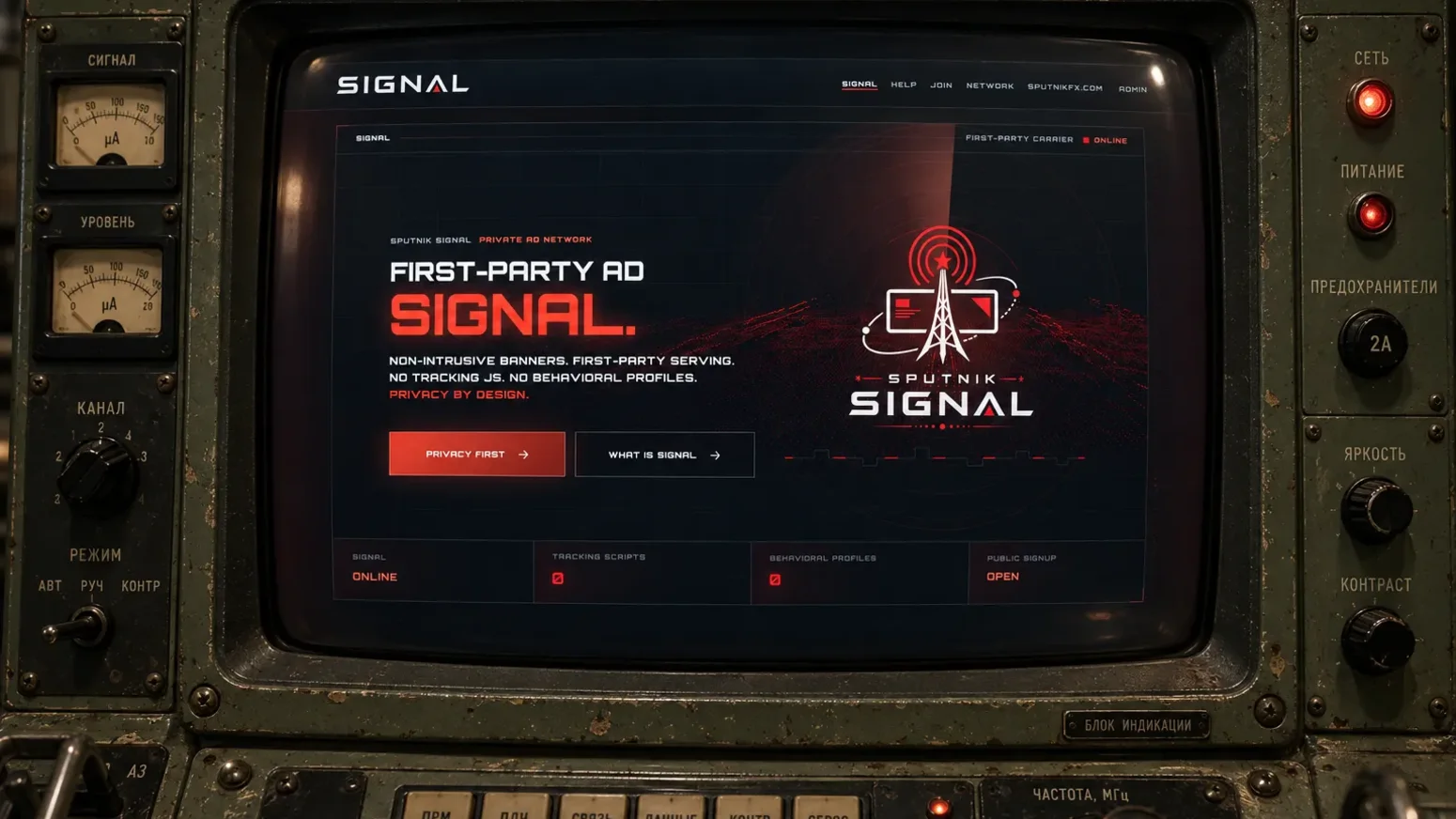
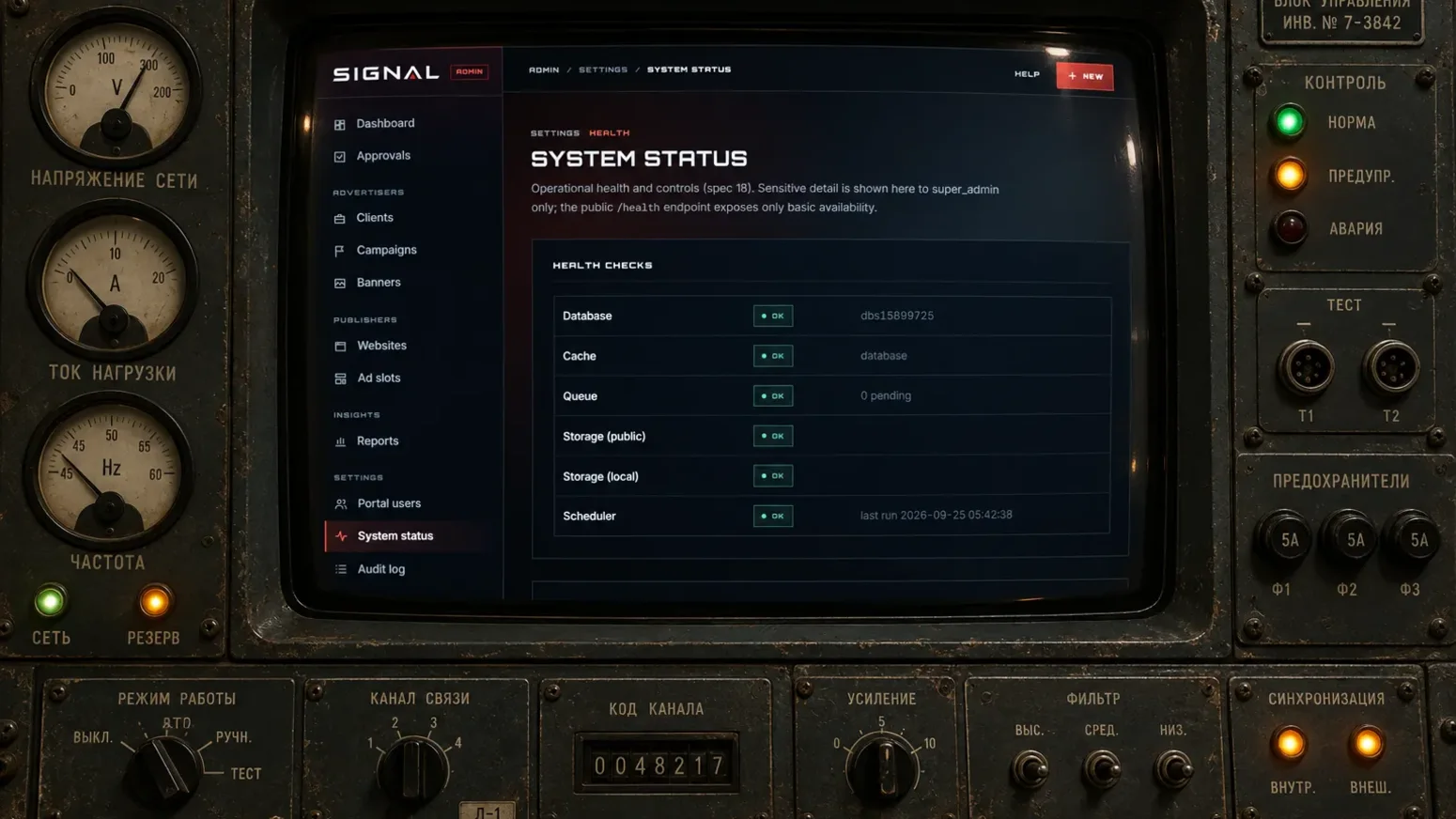
Sputnik Signal public network interface displayed inside a Soviet-era radar console
Account tracksAdvertiser · Webmaster · Both
Banner formats9 supported
Report scopesCampaign · Site · Slot · Creative
DeliveryFirst-party embed
Click attributionSigned redirects
01Delivery system

One request. A complete accountable chain.

An ad request has to choose a valid campaign, protect its budget under concurrent traffic, deliver the correct asset, measure a real view, and preserve click attribution.

Signal handles that chain through a versioned JSON API and a first-party asynchronous embed. Campaign targeting, domain approval, placement format, device fallback, budget state, and creative coverage are checked before an impression is claimed. A delivery receives one view credit. Clicks use expiring signed tokens rather than exposing campaign destinations in the page markup.

  • Weighted campaign selection
  • Atomic budget claiming
  • Domain eligibility checks
  • Responsive format fallback
  • Idempotent view recording
  • Signed click redirects
01Publisher embedAsync request from approved domain
02Eligibility enginePlacement, campaign, creative, target, budget
03Atomic claimOne impression reserved under transaction lock
04View + clickViewport proof and signed attribution

Systems review Production stack

The infrastructure behind the signal.

The useful part is not a single framework choice. It is how delivery, security, creative processing, reporting, and operations were made to agree under real browser traffic.

Sys 01

Application foundation

One production Laravel application separates the public network, self-service client portal, and operator console without a generic admin template.

  • Laravel 12 + PHP 8.4Controllers, policies, middleware, Eloquent models, queues, validation, and scheduled operations in one maintained application
  • Blade + vanilla JavaScriptServer-rendered public, portal, and operator interfaces with a small client footprint and no React or Vue runtime
  • MariaDB on InnoDBTransactional campaign, creative, placement, account, event, and aggregate data
  • Vite production buildCompiled interface assets with self-hosted typography and the Sputnik design system
Sys 02

Ad delivery pipeline

One asynchronous embed runs the complete request, viewability, and click chain without blocking the publisher page.

  • Versioned serving APIWeighted eligibility selection with no-store responses and an atomic impression claim
  • Idempotent view endpointA delivery can receive one view credit, even if the browser repeats the call
  • Signed click redirectsExpiring HMAC-SHA256 tokens protect click destinations and server-side campaign attribution
  • First-party embedAsync vanilla JavaScript uses IntersectionObserver to record a view only when the placement is visible
Sys 03

Creative processing

Uploaded artwork is inspected by its bytes, normalized for the web, and kept out of public storage until it clears validation.

  • Exact-size enforcementCreative dimensions must match the selected banner format before activation
  • WebP conversionJPG and PNG artwork is auto-oriented, stripped, compressed, and published as WebP
  • Animated media supportAnimated WebP and GIF files are validated without flattening their frames
  • Content-first securityThe pipeline ignores claimed extensions and MIME headers, then inspects the actual file bytes
Sys 04

Identity & security

Administrative control, client access, and public delivery endpoints use different guards and different permission boundaries.

  • TOTP multi-factor authenticationSuper administrators can enroll an authenticator and receive QR-assisted setup with recovery handling
  • Argon2id credentialsPasswords use a modern memory-hard hash rather than reversible storage
  • Role-scoped portalsEmail-verified advertisers manage their campaigns. Webmasters manage sites and ad slots. Analysts remain read-only
  • Hardened response layerHSTS, CSP, framing rules, referrer policy, permission policy, and endpoint-specific throttles
  • Audit trailAdministrative changes retain actor, action, subject, and before/after state for later review
Sys 05

Reporting & operations

Plain-language dashboards turn delivery events into useful campaign, site, ad-slot, and creative reporting.

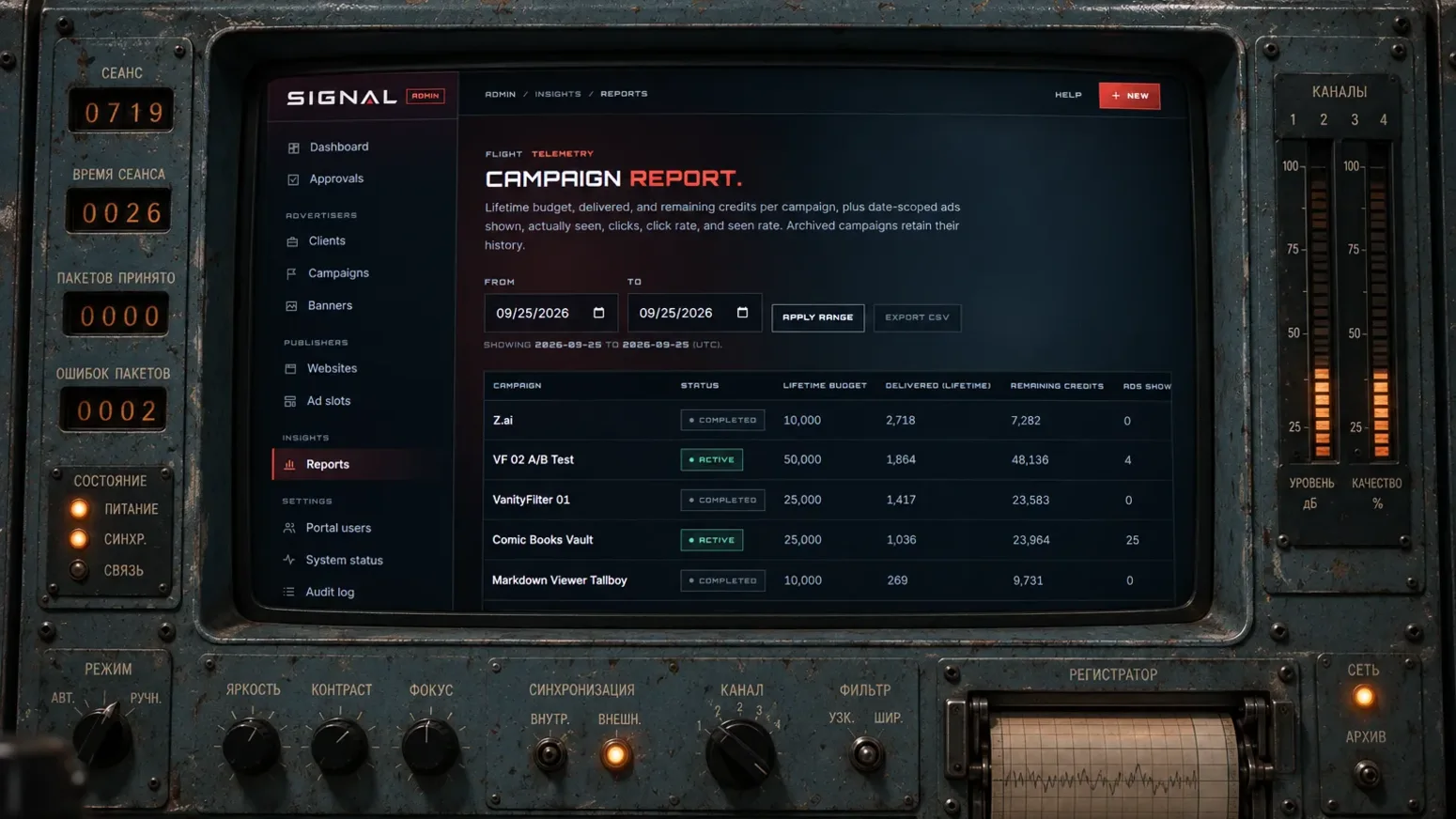
  • Four report scopesCampaign, site, ad-slot, and creative reports with date, format, and device breakdowns
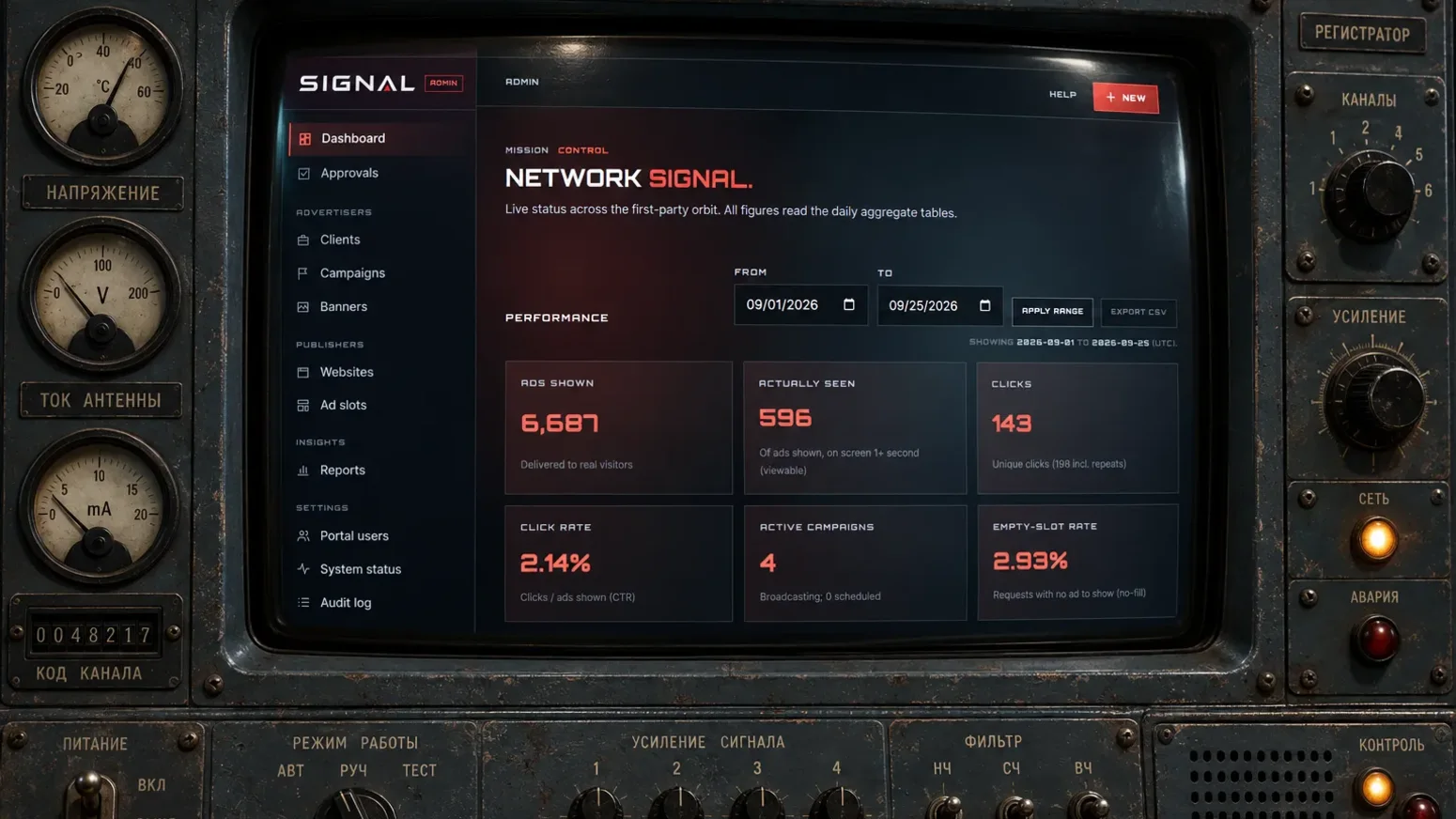
  • Operational dashboardAds shown, actually seen, clicks, empty slots, rejected requests, and likely bots in buyer-readable language
  • Seven scheduled jobsFive-minute rollups, state synchronization, heartbeat checks, reconciliation, purging, and retention work
  • CSV reconciliationExports use the same underlying totals as the dashboards rather than a separate reporting path
Sys 06

Verification & deployment

The network was tested as a delivery system, not only as a set of controller methods.

  • Production test suiteAutomated coverage exercises authentication, permissions, targeting, budgets, uploads, clicks, CORS, reporting, retention, and TOTP
  • Real-browser acceptanceLaravel Dusk verifies all nine formats, async loading, viewability, responsive fallback, clicks, and no-fill
  • Concurrency proofParallel workers compete for a limited budget without exceeding the allowed impression count
  • Production operationsTLS, health monitoring, scheduler heartbeat, additive deployment, backup, and rollback procedures are documented and live
02Trust boundaries

Security belongs in the product definition.

An advertising platform handles uploaded files, public traffic, client data, campaign destinations, and privileged controls. Each surface needs a different boundary.

Super administrators can add TOTP multi-factor authentication. Analysts are read-only. Advertisers and webmasters enter a separate role-scoped portal. Public serve, view, click, reset, and login routes receive their own throttles, while an audit log records administrative state changes for later review.

AuthenticationArgon2id + optional TOTP MFA
AuthorizationAdmin · analyst · advertiser · webmaster
Response policyHSTS · CSP · frame controls · rate limits
AccountabilityActor + action + before/after audit state

Need software that survives real traffic?

Bring the difficult part. Sputnik Digital Effects can take a platform from product rules through the interface, security model, test suite, and production launch.

Open project channel